Products › Dies & Tooling › Carbide Blocks
Tungsten Carbide Blocks for Stamping and Progressive Dies
Sintered tungsten carbide blocks, 100 × 100 to 300 × 300 mm and up to 80 mm thick, for punches, die plates and progressive die inserts.
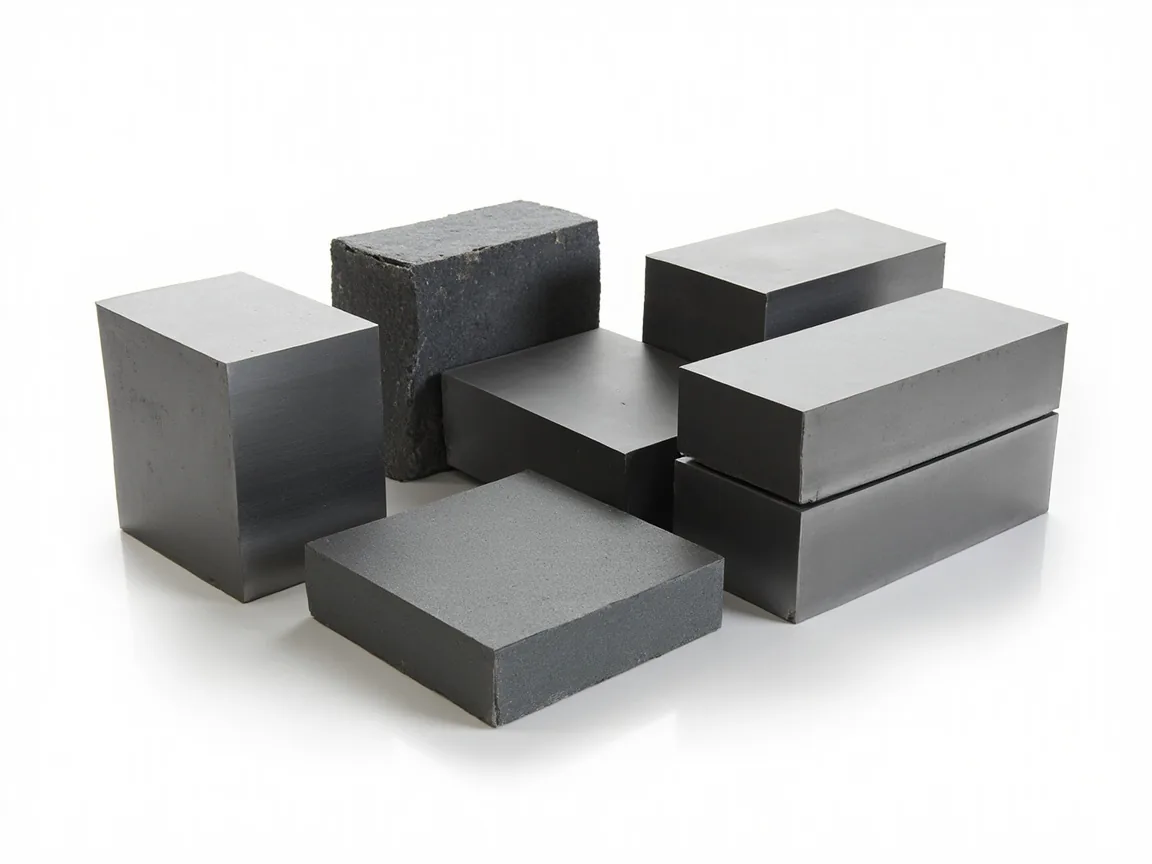
Carbide blocks are the starting material for punches, die plates and progressive die inserts that are cut by wire EDM or ground to shape. Block size, grinding allowance and grade are chosen together: the size from your finished insert, the grade from the material, thickness and speed you stamp.
Specifications
| Product | Sintered tungsten carbide blocks (block blanks) |
|---|---|
| Standard square sizes (L × B) | 100 × 100, 105 × 105, 120 × 120, 150 × 150, 200 × 200, 250 × 250, 300 × 300 mm |
| Rectangular sizes (L × B) | 100 × 50, 100 × 60, 100 × 72, 100 × 85 mm |
| Thickness (H) | 1–80 mm, depending on block size (300 × 300 mm: 10–30 mm) |
| As-sintered tolerance, L and B | 0/+1.5 mm to 0/+3.0 mm, by block size |
| As-sintered tolerance, H | +0.3/+0.6 mm |
| Cobalt content | 8–20% (by grade) |
| Hardness | 85.0–92.0 HRA (typical, by grade) |
| Transverse rupture strength | 3000–3800 MPa (typical, by grade) |
Typical applications
- Electronic progressive dies: lead frames and connectors in copper, brass and aluminium
- Thin stainless steel strip stamped at high speed
- Motor lamination dies: silicon steel, pure iron and cold-rolled sheet
- Compound dies and complex die shapes under heavy impact
- Punches and die inserts for powder metallurgy and general electronics
What we supply
- Square and rectangular sintered blocks; standard sizes listed under Specifications
- Other block sizes made to order
- Ground blocks or pieces cut to your size, on request
Grade Options
- Ultra-fine grain, about 10% cobalt (0.6–0.8 µm): 91.5–92.0 HRA, TRS 3600–3800 MPa. For thin copper, aluminium and stainless strip (under 0.2 mm) at high speed.
- Fine grain, 13.5–15% cobalt (0.6–0.8 µm): about 90.2–90.3 HRA, TRS 3800 MPa. For lead frames and connectors; copper, aluminium and stainless sheet under 0.4 mm at medium to high speed.
- Medium grain, 12% cobalt (1.0–1.5 µm): about 90.5 HRA, TRS 3200–3800 MPa. General-purpose grade for electronic and motor progressive dies.
- Medium grain, 12–15% cobalt (about 1.2 µm): 88.5–89.7 HRA, TRS 3500–3800 MPa. For motor lamination dies in silicon steel, pure iron and cold-rolled sheet.
- Coarser grain, 20% cobalt (about 2.0 µm): about 86.2 HRA, TRS 3450 MPa. For thick sheet under heavy impact, and for compound dies in complex shapes.
- Standard grades, 8–20% cobalt (about 1.6 µm): 85.0–89.9 HRA, TRS 3000–3400 MPa. For general motor, electronics and powder metallurgy dies.
Choosing the grade
Harder, finer-grained grades hold a sharp edge longer on thin, soft strip; more cobalt and a coarser grain resist chipping and cracking when the sheet is thicker or the die takes heavy impact. Property values above are typical values for each grade class. Tell us what you stamp, its thickness and the stroke rate, and we name the grade and send its data sheet.
Grade data (binder content, grain size, hardness, density, transverse rupture strength) is confirmed in writing for the grade we propose. How we choose grades →
For a fast quotation, send
- Finished insert or punch size, or the drawing
- Block size you need (L × B × H), if you already know it
- Material stamped, its thickness and the stroke rate
- Machining route: wire EDM, grinding or both
- Quantity
Questions buyers ask
What sizes do carbide blocks come in?
Standard square blocks run from 100 × 100 mm to 300 × 300 mm, plus 100 mm long blocks 50, 60, 72 and 85 mm wide. Thickness ranges from about 1 mm on the smaller blocks to 80 mm; the largest 300 × 300 mm blocks are made from 10 to 30 mm thick. Other sizes are made to order.
How much grinding stock does an as-sintered block have?
As-sintered blocks are made oversize: thickness is +0.3 to +0.6 mm over nominal, and length and width are 0 to +1.5 mm up to 0 to +3.0 mm depending on block size. Send the finished size you need and we will specify the block that leaves enough stock.
Which carbide grade is used for silicon steel lamination dies?
Grades made for motor lamination dies are medium-grain with 12–15% cobalt (around 88.5–89.7 HRA). For thick silicon steel or cold-rolled sheet under heavy impact, a 20% cobalt grade is less likely to chip.
Which grade is used for copper connector and lead frame stamping?
Fine and ultra-fine grain grades with 10–15% cobalt (about 90–92 HRA). The thinner the strip and the higher the speed, the more it pays to go finer and harder.
Do you supply round blanks for die buttons and punches?
Yes. Round blanks for die buttons and punches are supplied to your drawing, as-sintered or ground. See Punch & Stamping Die Blanks, or Solid Carbide Rods for straight round stock.